
TheTimeo / Bridal
The Tiffany Setting:
six points of light
The Tiffany Setting begins with a round diamond and six prongs. Follow the line beneath the stone, then see how a plain or diamond-set band changes its presence.
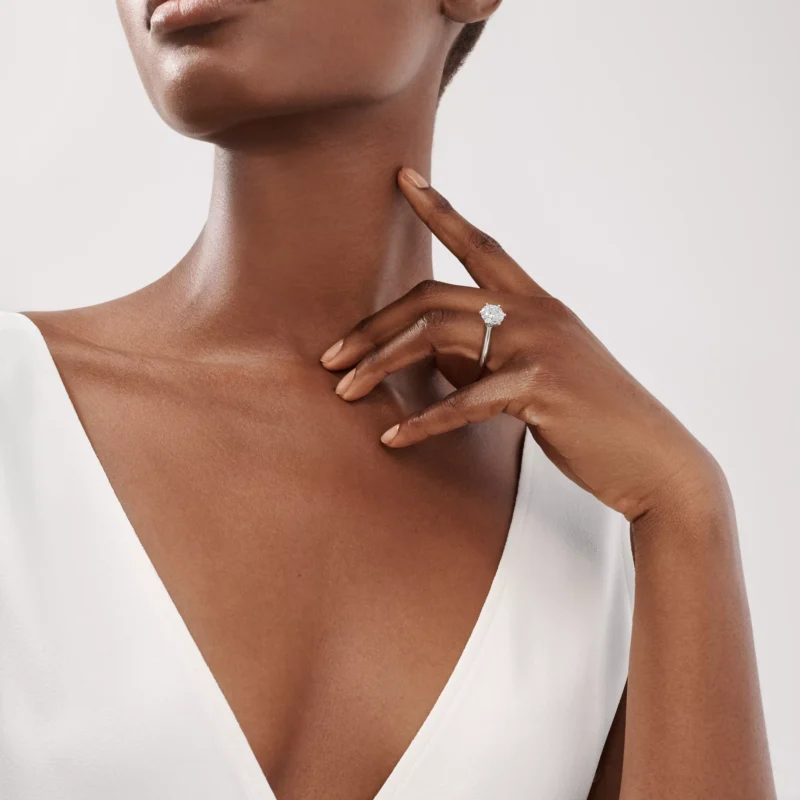
A solitaire seen with the hand and neckline. Courtesy of Tiffany & Co.
Explore the story
A round diamond, a narrow band and six small points holding the centre: the Tiffany Setting has a silhouette that can be recognised with very little information. The most interesting line, however, appears below the stone. Turn to the profile and the setting opens into a raised, crown-like shape above the circle of the ring.
That side view makes an engagement ring feel less like a bright dot in a photograph and more like an object that will accompany a hand. The views here follow its construction, then compare the quieter surface of a plain band with the detail of diamond-set versions. The question is where you want the eye to linger.
The face and the silhouette
01 / 02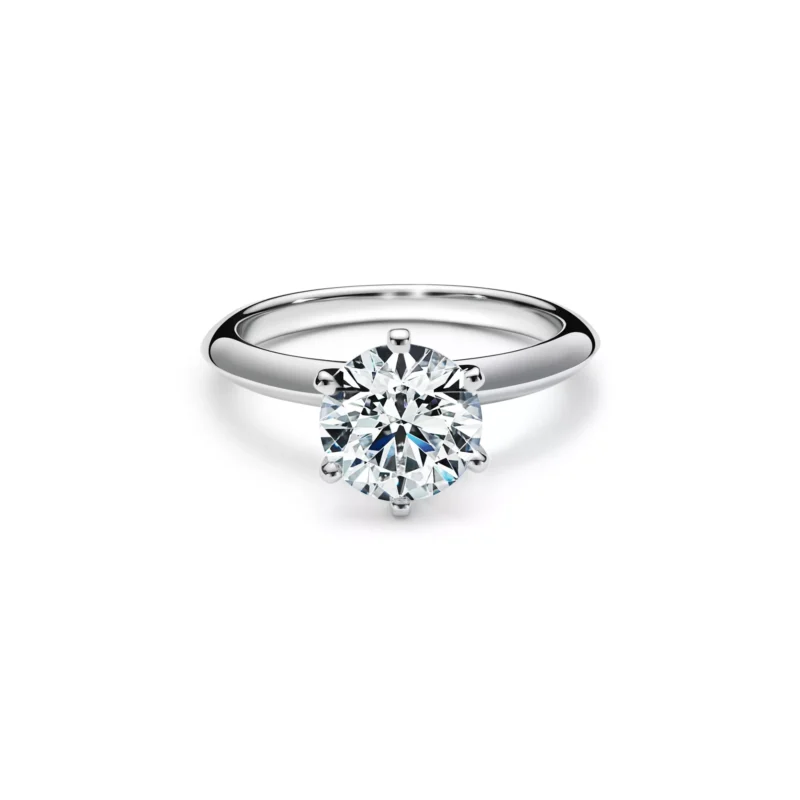
The plain band gives the round centre a clear outline. Courtesy of Tiffany & Co.
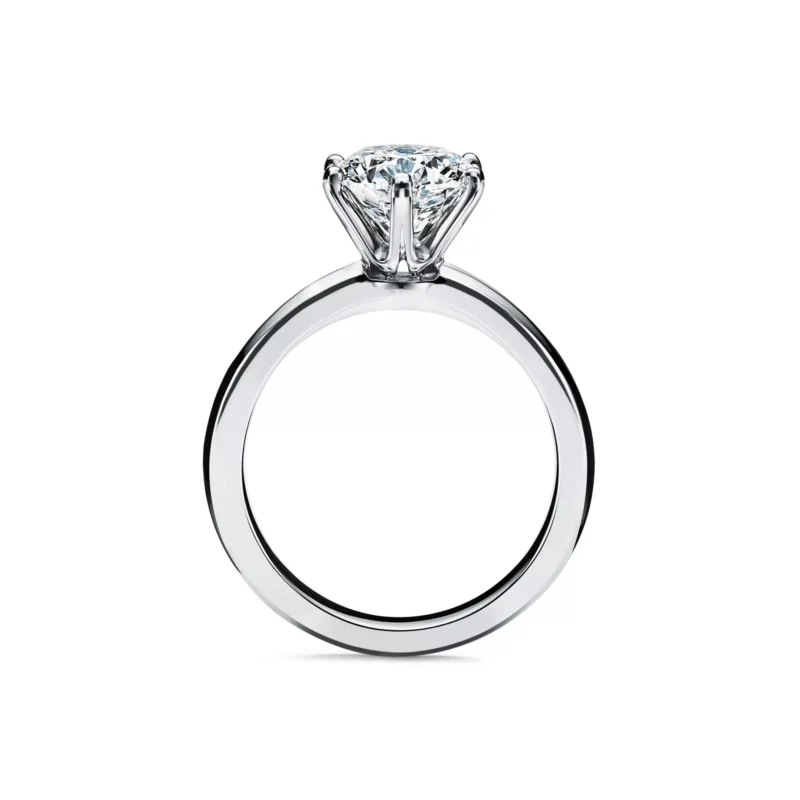
The elevated six-prong profile beneath the diamond. Courtesy of Tiffany & Co.
From the front, the diamond interrupts an otherwise simple circle. The band curves towards the centre, leaving the round stone as the strongest shape. From the side, the balance changes: the upper structure opens outwards and the diamond sits visibly above the band. A familiar ring suddenly has a clear direction of travel, from finger to crown.
Tiffany dates the introduction of the Setting to 1886 and identifies its six-prong mount as a defining feature. The prongs are the metal tips holding the diamond in place. In the profile photograph, their supports form a series of lines beneath the stone, giving the upper part of the ring its distinctive outline.
Looking at these two views together offers a useful way to compare solitaires. The face tells you how the centre reads at a glance. The side reveals the form that accompanies it. Take time with both before deciding which detail you find most attractive.
A band changes the conversation
A plain band gives the eye a continuous surface to follow before it reaches the diamond. Its restraint can make the centre feel particularly distinct. In the diamond-set versions, small stones create detail along the shoulders, extending the pattern beyond the principal stone. The ring offers something to notice along more of its circumference.
The difference need not be framed as a choice between discreet and extravagant. Think instead about the jewellery you enjoy looking at closely. Do you return to a clean curve of metal, or to a surface made of many small elements? The answer may already be present in the watch, earrings or bracelet you wear most often.
A solitaire is often photographed alone, but you will see it among other things. A wedding band introduces a second line; an existing ring on the other hand supplies another point of interest. Consider the whole arrangement before deciding how much detail you want the engagement ring itself to carry.
If photography is welcome during your appointment, keep a face-on image and a side view of each version you seriously consider. Use a similar hand position and distance for both. Later, that small pair can help you remember whether you were drawn to the outline of the setting, the surface of the band or their relationship together.
Light along the shoulders
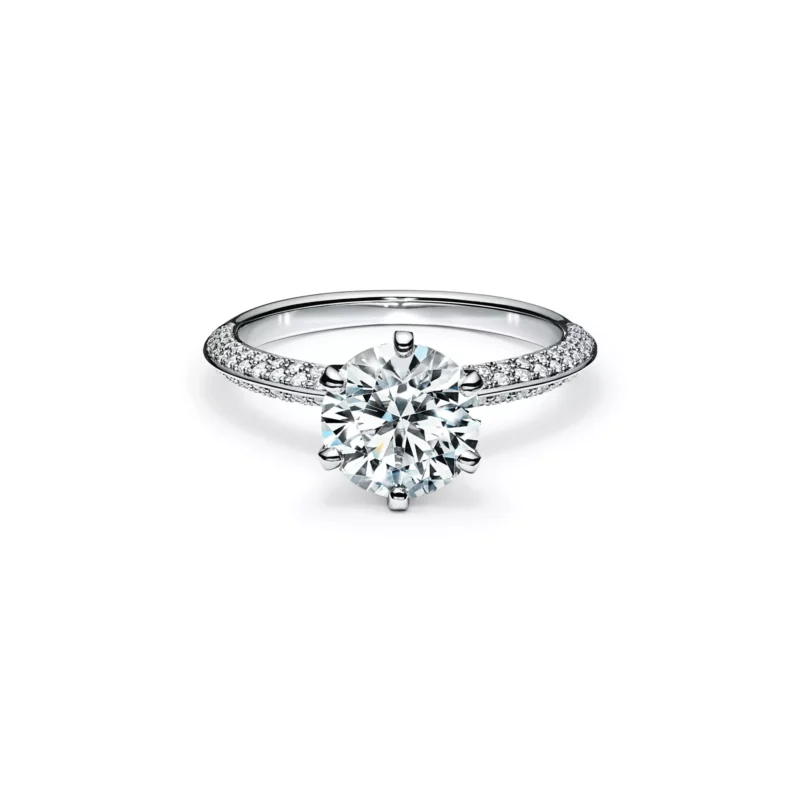
The smaller diamonds continue along the curved shoulders. Courtesy of Tiffany & Co.
In this diamond-set view, the shoulders remain visible as fine arcs on either side of the centre. The smaller stones describe those arcs rather than concealing the overall circle. The upper setting and the decorated band can be read separately, which makes their meeting worth a closer look.
Look first at the centre, then let your attention move outwards. The rhythm changes as the larger diamond gives way to a repeated sequence of smaller stones. If that transition is what attracts you, compare it at normal viewing distance as well as in an enlarged photograph. The detail you enjoy close up should also make sense as part of the hand.
The photographs show individual versions. Their visual comparison is an invitation to explore the design, rather than a specification for every ring currently offered. For the version you try, let the actual ring establish the proportions you are choosing.
A fitting in two views
Let the hand rest
Place your hand in a comfortable position and allow your eye to take in the whole ring. Look at the relationship between centre, band and finger. Bring the wedding band you expect to wear, or ask to compare suitable examples, so the two rings become one visual decision.
Turn towards the profile
See how the setting rises above the band and how you feel about that shape from the side. Try it beside the sleeve and other jewellery you wear often. A profile you enjoy noticing can become as personal as the first view of the diamond.
The small architecture beneath
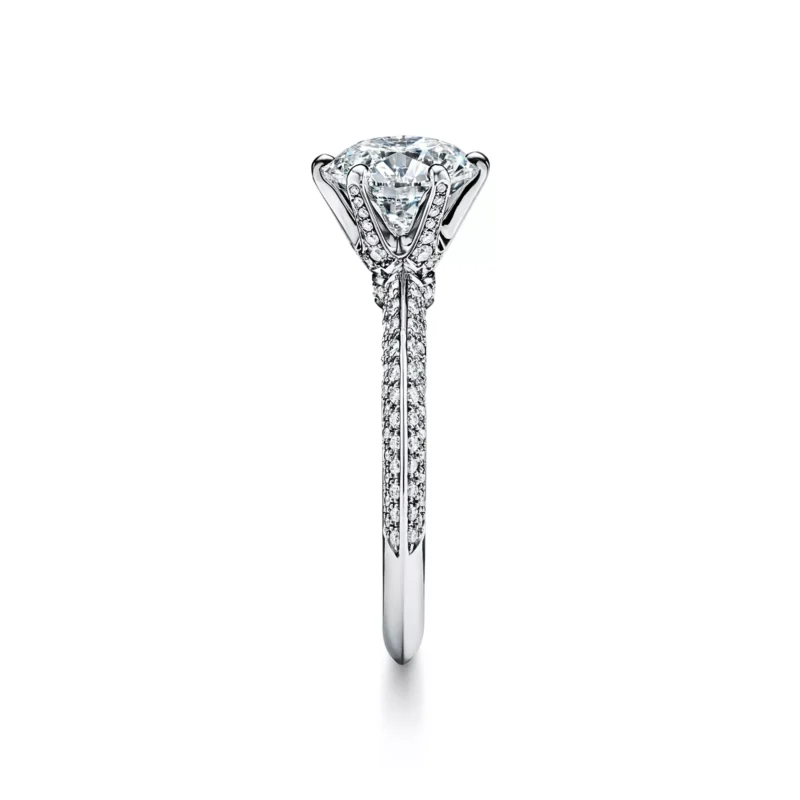
An end-on view reveals the lines beneath the main diamond. Courtesy of Tiffany & Co.
Seen end-on, the diamond-set shoulders lead towards an intricate structure under the centre. This angle is easy to miss when choosing from a row of face-on photographs. It gives the ring another visual register: a pattern of supporting lines and small bright surfaces beneath the familiar round stone.
The interest lies in looking at a part that will often be glimpsed rather than studied. A turned hand, a resting wrist or a movement towards the face can bring the side into view. You do not need to make that hidden detail the reason for your choice, but it is worth seeing before you settle on one.
A ring can be simple in its overall image and detailed in its construction. The Tiffany Setting invites that double reading. Its round centre is immediately legible; the profile gives you a second shape to recognise. Spend enough time with both to decide which version feels complete to you.
Sources & further reading
The Edit
Bridal stories
Selected stories from the same editorial universe.
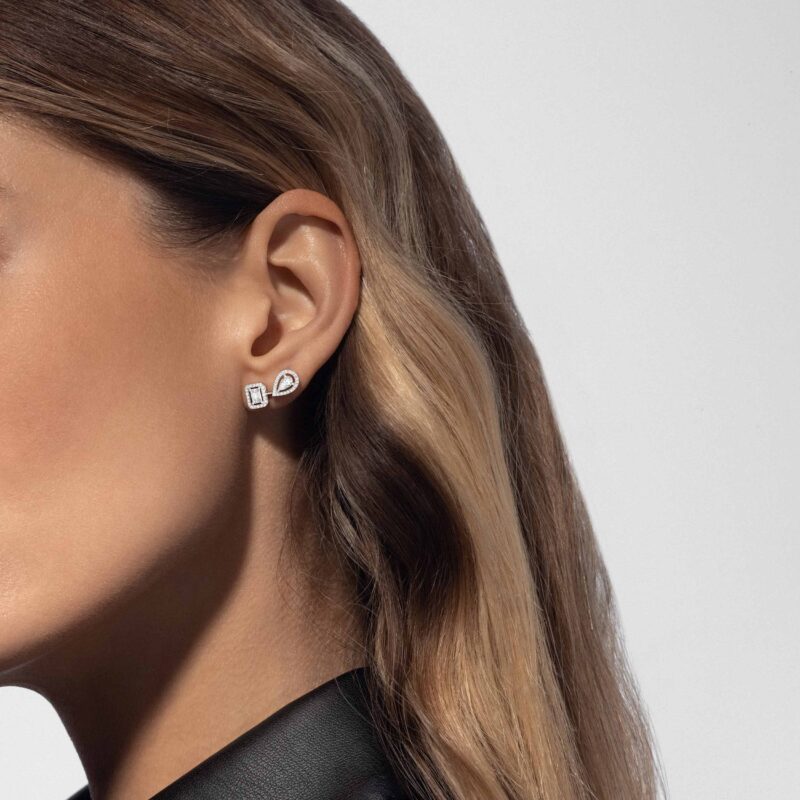
Messika My Twin: Two Cuts, One Bridal Look
An emerald cut, a pear and an unequal pair: the small asymmetry of Messika

Two Rings, Two People: A De Beers Wedding-Band Edit
A rose-gold court profile, a single diamond in platinum, a fine eternity line or
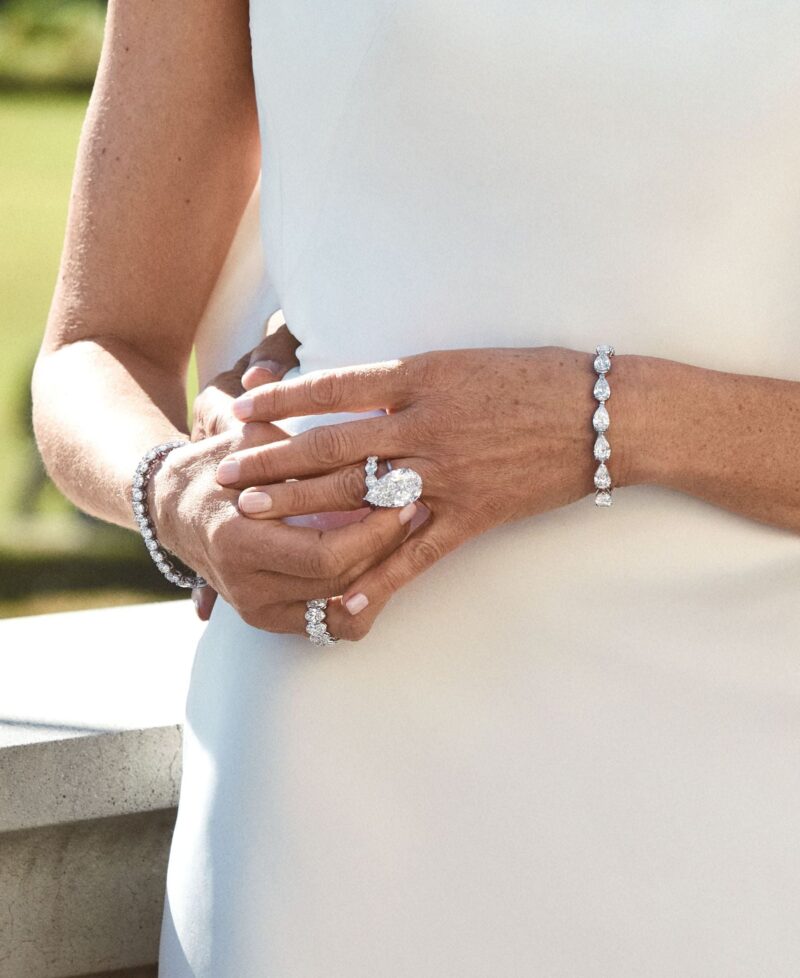
Norman Silverman Bridal: A Ring with Presence
A pear solitaire on the hand, a radiant seen in profile and an emerald-cut
Harry Winston Beyond the Ring: Choosing the Wedding-Day Jewels
The engagement ring does not have to carry the whole wedding look. Harry Winston’s
Why Leave a Diamond Rough? What De Beers Talisman Still Preserves After Twenty Years
A rough diamond arrives with its own geometry. Twenty years after Talisman, De Beers
Beyond the 4Cs: Choosing an Engagement Ring for Everyday Life
The diamond report is only half the decision. Height, setting, shoulders, sizing and the